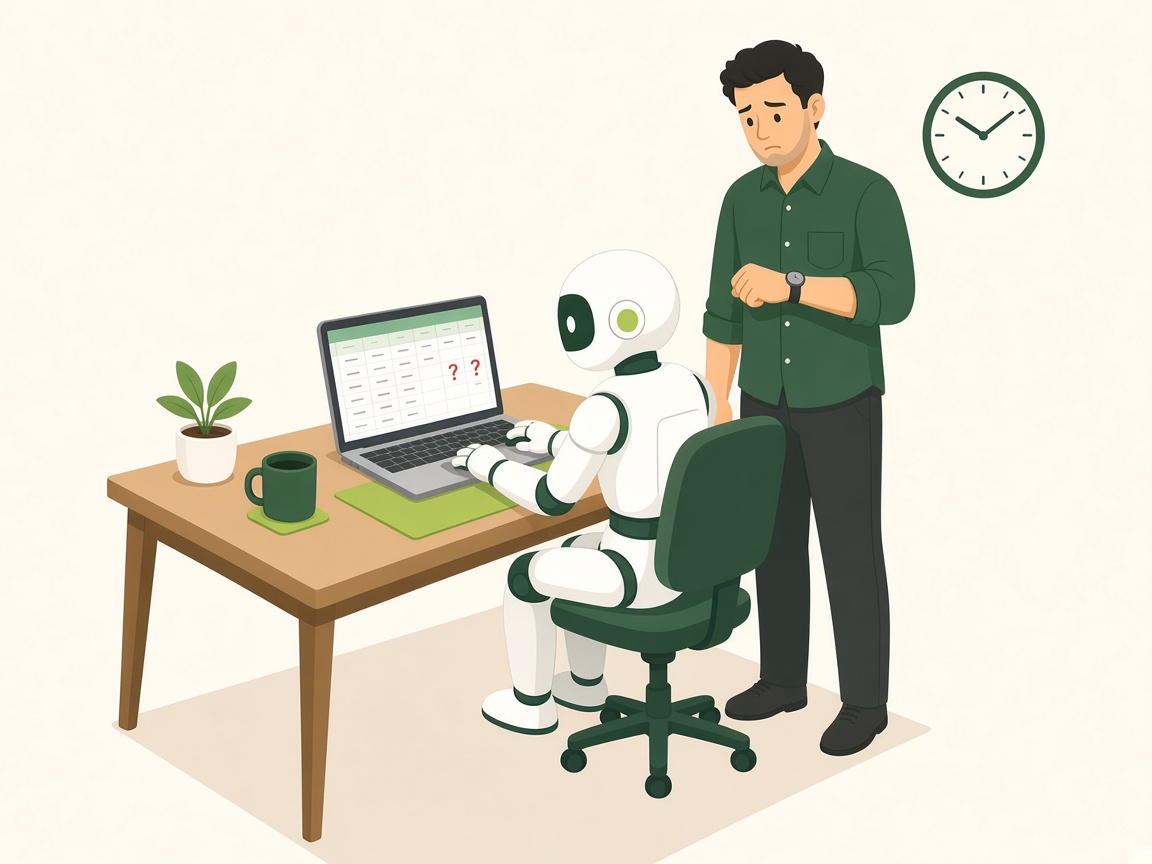
AI can do a lot of bookkeeping tasks now.
That part isn’t really up for debate.
The better question for a business owner is a different one:
should you be the one running it?
Because "AI does my books" usually means something more like
"AI does a first draft of my books, and I’m responsible for the rest."
That gap between the first draft and the finished books is where this whole decision lives.
What AI is genuinely good at
Credit where it’s due. Modern tools are fast at the repetitive parts:
- Sorting hundreds of bank and card transactions into categories in seconds
- Learning patterns, like "this vendor is always software"
- Matching a receipt photo to the charge it belongs to
- Suggesting which deposit pays which invoice
That’s real work, and it used to take hours.
But notice what all of those have in common.
They’re pattern tasks. The AI is guessing based on what a transaction looks like.
Bookkeeping isn’t only about what a transaction looks like.
It’s about what it is.
Where the judgment lives
A bank feed tells you an amount, a date, and a description.
It doesn’t tell you why the money moved.
That "why" decides where it belongs in your books. And it’s usually something only you, or someone who knows bookkeeping, can answer.
Here are a few everyday situations. They’re examples, not real clients, but anyone who has cleaned up a set of small-business books will recognize them.
The deposit that isn’t income
A large deposit lands in the business account. It looks like a sale, so it gets booked as revenue.
It was actually loan proceeds. A loan is money you owe back, not money you earned.
Booked as income, it makes the business look more profitable than it is, and it can overstate what you report for taxes.
The loan payment that’s only partly an expense
Every month the same loan payment goes out. It gets categorized as "Loan expense."
But each payment is a mix: part interest, which is an expense, and part principal, which just reduces what you owe.
Treating the whole payment as an expense understates profit and leaves a loan balance on your books that no longer matches the lender’s statement.
Owner’s draw vs. expense
An owner of a single-member LLC moves money from the business to their personal account to pay themselves.
To a pattern-matcher, it can look like a payment to a person, so maybe "Contract labor."
It’s an owner’s draw. That isn’t a business expense. Calling it one inflates deductions you may not be able to support.
The transfer counted twice
Money moves from checking to savings, or from checking to pay the business credit card.
Both accounts are connected, so the tool sees two transactions: money out of one, money in to another.
If each side gets categorized on its own, as an expense on one end and income on the other, you’ve created activity that never happened. A transfer should net to zero.
The payout that hides your real sales
A card processor or online platform deposits a payout. It’s your sales minus fees, refunds, and sometimes sales tax collected.
Booked as one deposit of "Sales," your revenue is understated, your fees disappear, and sales tax you’re holding for the state looks like money you earned.
The total in the bank is right. The story underneath it isn’t.
The personal charge on the business card
A family dinner or a personal online order goes on the business card. The vendor looks like dozens of legitimate charges, so it lands in "Meals" or "Supplies."
Nobody notices until someone asks for support for that deduction.
"But it reconciled"
Reconciliation is important. It’s also widely misunderstood.
A reconciliation confirms that the transactions in your books add up to what the bank says.
It does not confirm that those transactions are in the right categories.
Every example above can reconcile perfectly. The loan booked as income reconciles. The owner’s draw booked as an expense reconciles. The payout booked as one lump of sales reconciles.
So a clean reconciliation is a necessary check, not a guarantee.
And an AI that reports "reconciled" is telling you the cash matches, not that the books are right.
AI doesn’t remove the knowledge. It moves it.
This is the part that’s easy to miss.
Before AI, the knowledge was needed to do the work.
With AI, the knowledge is needed to review the work.
And reviewing only works if you know what you’re looking at.
An AI will give you an answer.
It won’t always tell you it’s guessing.
If you can’t spot that a deposit is a loan, or that a payout is net of fees, the review step becomes a click-through. The books look finished. They just aren’t right.
The hidden cost: your time
Running bookkeeping with AI isn’t one task. It’s several:
- Learning the tool and the basics of how the books should be set up
- Setting up accounts, categories, and rules, and fixing the rules when they misfire
- Reviewing every month: what got categorized, what got matched, what’s still uncategorized
- Fixing what’s wrong, which means first knowing it’s wrong
- Cleaning up at year-end, when your tax preparer asks questions the books can’t answer
The last one is the expensive one. Mistakes found months later take longer to unwind than mistakes caught the week they happened, and the cleanup often lands at the busiest time of year.
Estimate, honestly, the hours each month you’d spend learning, setting up, reviewing, and fixing.
Multiply them by what an hour of your time is worth when you spend it running the business: selling, serving customers, managing people.
Then compare that number with a bookkeeper’s monthly fee.
For a lot of owners, the first number ends up bigger.
Not because AI is bad, but because their hour is worth a lot.
And that comparison doesn’t even count the cost of the errors that slip through.
When doing it yourself with AI can make sense
- Your books are simple: one account, one card, few transactions
- No loans, no inventory, no payroll, no sales tax
- You already understand bookkeeping and can review with confidence
- You genuinely enjoy it, and the time isn’t pulling you from higher-value work
- You have loans, multiple accounts, or money moving between them
- You sell through card processors or online platforms
- You run payroll, collect sales tax, or carry inventory
- Business and personal spending sometimes mix
- You’d be learning bookkeeping in order to check the AI
Neither side is a rule. It’s a way to be honest about where your books, and your time, actually are.
The real question
AI is a powerful tool for bookkeeping.
Good bookkeepers use it too.
The question isn’t whether AI can do your books.
It’s whether your time and attention are best spent managing it.