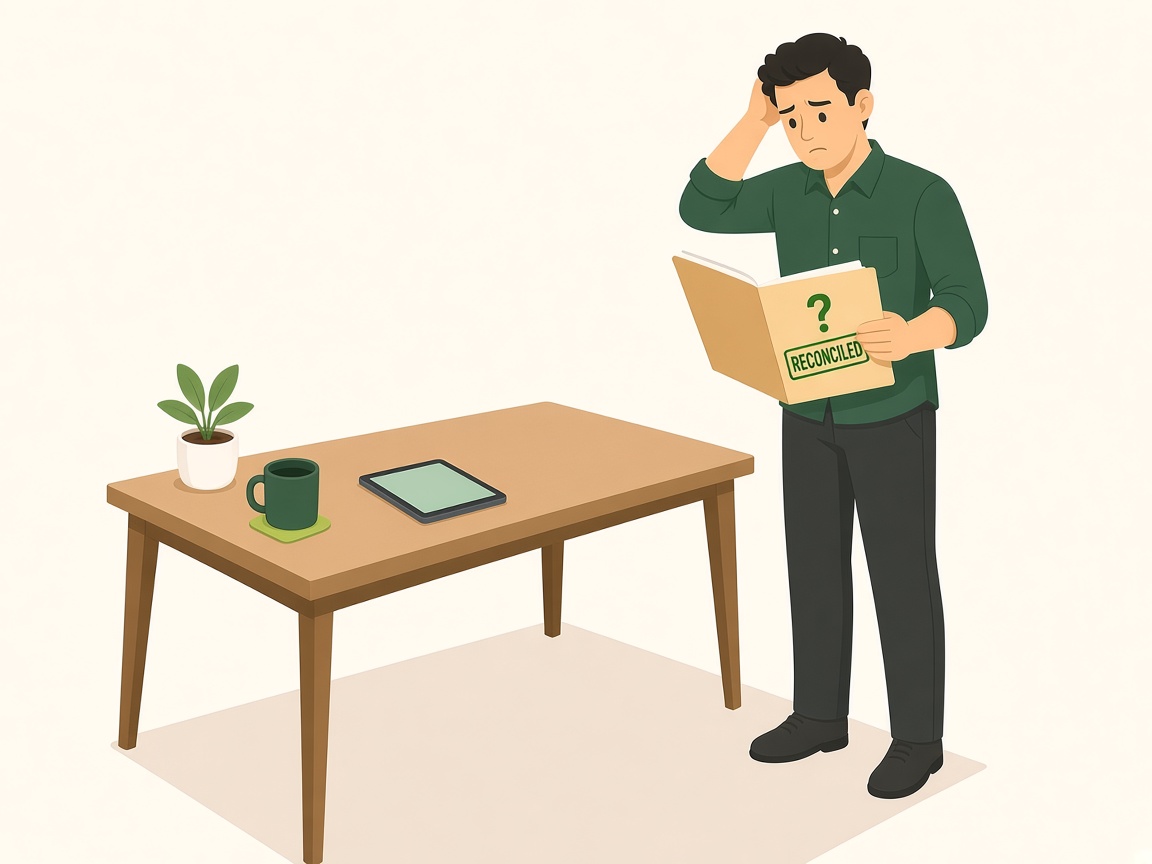
Your bank account reconciles.
The reports open without errors.
Everything looks fine.
That’s a good sign. It just isn’t the same as books you can trust.
Books can match the bank to the penny and still tell the wrong story about your business: what you earned, what you spent, what you owe, and what you took home.
The difference usually shows up at the worst time. At tax time, when a lender asks for financials, or when you’re making a decision based on a profit number that was never quite right.
What reconciliation actually proves
Reconciling means the transactions in your books match the transactions on your bank or card statement, and the ending balances agree.
That’s worth doing every month. It catches missing transactions, duplicates, and bank-feed hiccups.
But reconciliation answers one question: did every dollar that moved get recorded?
It doesn’t answer the more important one: was each one recorded as the right thing?
A deposit booked as a sale and the same deposit booked as a loan both reconcile. So does a transfer booked as an expense. The bank balance is right either way. Your profit, your balance sheet, and your tax picture are not.
Where “fine” goes wrong
Most problems come from a handful of everyday transactions that look simple in a bank feed but mean something specific in the books. These are examples, not real clients, but they come up constantly.
The transfer that became an expense
Money moves from checking to savings, or checking pays off the business credit card.
If the savings or card account isn’t connected to the books, the outgoing side has nowhere to land, so it gets categorized as an expense.
Nothing was spent. Money just moved between two accounts you own. Your expenses are overstated, your profit looks lower than it is, and the savings or card balance in your books doesn’t match reality.
The owner’s draw hiding in payroll or contractors
An owner pays themselves by moving money to a personal account. In the feed, it looks like a payment to a person, so it lands in “Contract labor” or “Wages.”
For many small businesses, that money is an owner’s draw. It reduces equity. It isn’t a business expense.
The reverse happens too: an owner puts personal money into the business, and it gets booked as income. Either way, the profit number stops meaning what you think it means.
The loan that was never set up
A business takes out a loan or a line of credit. The deposit arrives and gets booked as revenue. Each monthly payment gets booked as one big expense.
Now income is overstated in the month the loan arrived, expenses are overstated every month after, and there’s no loan balance on the books at all.
Done right, the loan is a liability. The deposit increases it, the principal part of each payment reduces it, and only the interest is an expense. At any point, the balance in your books should match what the lender says you owe.
The account nobody reconciles
A line of credit, a vehicle loan, or a payroll clearing account isn’t reconciled at all, because only checking and the main card are.
The checking account looks perfect. Meanwhile the other balances slowly drift away from their statements, and nobody notices because nobody looks at the balance sheet.
Why it matters for taxes
Your tax return is built from your books. If transfers are counted as expenses or draws as deductions, the return can claim costs that were never really business costs.
If loan proceeds or owner contributions are counted as income, you could report more than you actually earned.
Neither is a situation you want to sort out after the fact, with a deadline coming or a question from the tax authority sitting on your desk.
Why it matters for decisions
Even when taxes aren’t the issue, the numbers drive real choices: whether you can hire, whether a price increase is needed, whether a slow month is a trend or a blip.
If the profit and loss statement is off in a consistent direction, every one of those decisions starts from the wrong place. And because the books “look fine,” there’s no reason to question them.
A few quick checks you can do yourself
You don’t need to be a bookkeeper to spot the most common warning signs. Open your balance sheet and profit and loss and look for:
- Loan and credit-line balances that don’t match the latest lender statement
- Savings, card, or clearing accounts with balances that don’t match their statements
- Expense categories with transfers or round-number payments to yourself inside them
- Income lines that include deposits you know weren’t sales
- An “Uncategorized” or “Ask my accountant” bucket that keeps growing
- An owner’s equity or draw account that’s empty, even though you pay yourself
If any of those turn up, it doesn’t mean the books are a mess. It means they’re worth a closer look before you rely on them.
Pick one account you rarely look at, like a loan, a line of credit, or savings. Compare the balance in your books to the latest statement.
If they match, great. If they don’t, that gap is usually the first thread to pull.
What trustworthy books look like
Trustworthy books aren’t just reconciled. They’re reviewed.
- Every bank, card, loan, and clearing account is reconciled, not just checking
- Transfers are recorded as transfers and net to zero
- Owner draws and contributions sit in equity, not in income or expenses
- Loans are set up as liabilities, with interest split out from principal
- Someone looks at the balance sheet, not only the profit and loss, every month
None of that is complicated on its own. It just takes consistent attention, and knowing what each transaction actually is, not only where the money went.
The real question
Reconciled books are a starting point.
They aren’t the finish line.
The question isn’t whether your books balance.
It’s whether you’d be comfortable making a decision, or filing a return, based on them.